

Custom Foam Products and Fabrication Services:
The Royal Foam Art Design Catalog
The Royal Foam Art Design Catalog

Choosing a supplier for a large custom object usually starts with a simple question that is surprisingly hard to answer: what exactly should I be asking for? A brand manager planning a store launch, an architect adding an entrance feature and an event producer building a stage set all need three-dimensional work, but they need very different things. This page is a map of everything we make, written so that you can find the right starting point in a few minutes.
Royal Foam Art Design is a custom fabrication studio in Jacksonville, Florida. Since 1999 we have built 3D fabrication projects for clients across the United States, from custom 3D fabrication of architectural shapes to custom foam sculptures, custom 3D foam signs and detailed props. Every product group below has its own page with examples, materials and ordering details. Here you will find the short version of each, plus guidance on how to choose between them.
How our catalog is organized
The catalog contains more than thirty product lines. They can look like a long list at first, but they fall into six families, and most projects belong clearly to one of them.
Brand and retail environments cover activations, windows, visual merchandising and interior installations. Events, stage and entertainment cover props, trade show displays, seasonal decor and themed spaces. Sculptures, characters and replicas cover figurative and product-shaped pieces. Signs, letters and logos cover everything that carries a name. Architectural shapes and structures cover building elements, arches and monuments. Technology and tooling covers industrial 3D printing and molds.
If you already know the family, jump straight to it. If not, the quick finder further down will point you in the right direction.
Brand and retail environments
Retail and brand work has one purpose: to stop a person who was about to walk past. The objects in this family are designed for that moment.
Brand Activation Props are the pieces that turn a pop-up or promotional event into something people photograph. They are built to be assembled quickly, moved between venues and reused. Mall Activation Props are made for high-traffic public spaces, where scale and durability matter because thousands of people pass each day.
Custom Window Displays and Retail Visual Merchandising work at the point of sale. A window piece catches attention from the sidewalk. A merchandising prop lifts a product from the shelf and gives it a story. Both are lighter than traditional fixtures, so staff can change them with the season.
Retail Interior Installations go further and shape the inside of a store, with feature walls, hanging structures and large focal points. Reception Area Displays give offices and lobbies a signature object, such as a dimensional logo, that tells visitors who they are dealing with before anyone says a word. And 3D Logo and Branding Installations turn a flat identity into a physical landmark.
Events, stage and entertainment
Event work is defined by deadlines. The date does not move, so the product has to arrive complete, travel well and go up without drama.
Event Props and Decor covers backdrops, giant letters, photo opportunities and themed elements for corporate gatherings, festivals and private celebrations. Foam Trade Show Displays are exhibit structures that are light enough to ship and strong enough to survive repeated assembly.
Foam Stage and Movie Props serve theaters, studios and productions that need convincing surfaces without the weight, danger or cost of the real material. Columns that look like marble, walls that look like stone and set pieces that can be carried by two people are typical requests.
Custom Holiday and Seasonal Decor produces the large centerpieces that make a mall or town square memorable. Escape Room and Theme Park Props create immersive environments where guests touch, climb and photograph everything. Museum Exhibits and Replicas recreate objects, scenes and scale models for institutions that need accuracy as much as appearance.
Sculptures, characters and replicas
This family is the most figurative. Here the form itself is the message.
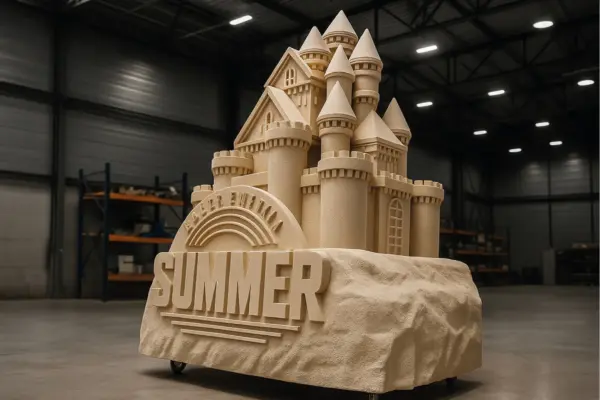
Custom Foam Sculptures can imitate wood, stone or metal and still be light enough to carry, ship and reuse. Custom Foam Characters bring mascots, cutouts and invented figures into three dimensions for events and brands. Custom Oversized Foam Product Replicas enlarge a real product, such as a bottle, a shoe or a device, to a scale that dominates a space and draws a crowd.
These pieces depend heavily on surface work. A good sculpture is the result of careful modeling, hand finishing and color matching, and this is where our workshop spends much of its time.
Signs, letters and logos
Signage is the largest group in our catalog, because every business has a name and wants it seen.
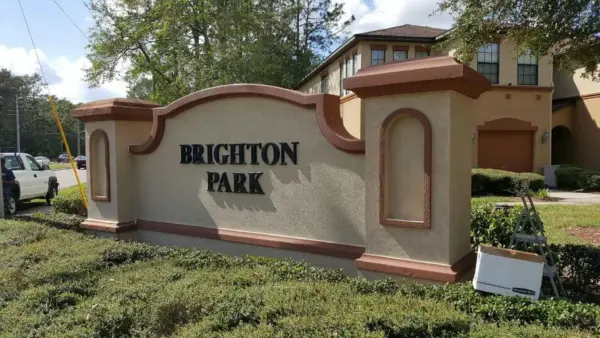
Foam Monument Signs are entrance signs for developments, campuses and commercial properties. Foam Routed Signs use carved detail for a crafted look, and Sandblasted Signs deliver a traditional textured finish without the weight of timber or stone.
For lettering, the choice is mostly about material and lighting. Oversized Foam Letters and Logos deliver scale at a low weight. Illuminated Letters and Outdoor LED Signs work after dark. PVC Letters and Logos and Acrylic Letters and Logos give clean, precise edges for interiors and facades. Small Metal Letters suit refined, compact applications. Floating Pool Letters are made to sit on water, for resorts, events and photo moments.
Architectural shapes and structures
Architectural foam is the quiet part of the catalog. Visitors rarely notice it, because the aim is for it to look like it belongs to the building.
Architectural Shapes include cornices, columns, pediments, arches and other decorative elements that add character without adding structural load. Wedding Arch Colonnades provide elegant, repeatable backdrops for ceremonies and venues. Designs for Places of Worship produce ornamental and symbolic elements that match a congregation’s architecture and budget.
The common advantage across this family is weight. A foam cornice can be handled by a small crew with ordinary equipment, which changes the economics of installation.
Technology and tooling
Two product lines sit behind the others and make a number of them possible.
Industrial 3D Printing uses large-format printers, with Fused Deposition Modeling or Selective Laser Sintering chosen according to the part, to produce shapes that cannot be cut or carved conventionally. Custom Cast Stone Molds for Commercial Signs supply the tooling that cast stone producers need to make signs in the shape their clients want.
What our services include
| Service Type | Description |
|---|---|
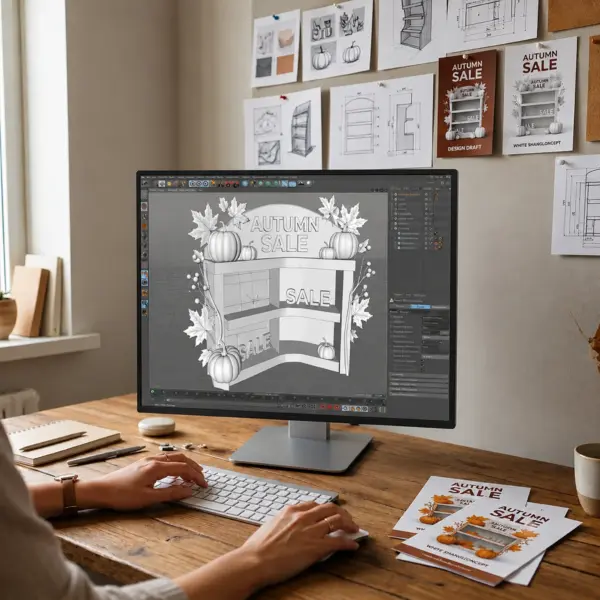
| 3D Fabrication Service | A complete cycle from idea to installation-ready product. We analyze the design, build a model and prepare samples. After documentation is approved, we manufacture, pre-assemble sections where we can and pack the piece securely. |
| 3D Model Fabrication | Every shape starts as an exact digital model. Geometry, proportions and details are confirmed before production, which prevents errors and protects the schedule. |
| 3D Printing Fabrication | Printed components are used where fine precision is required and are joined to foam cores for a balance of strength, accuracy and cost. |
| 3D Fabrication Detail Modeling | Wood grain, stone, concrete, metal finishes, soft transitions and worn edges are recreated so that the finished piece looks realistic and premium. |
| Custom foam sculptures | Light, durable sculptures that look like wood, stone or metal and are simple to carry, install and reuse. |
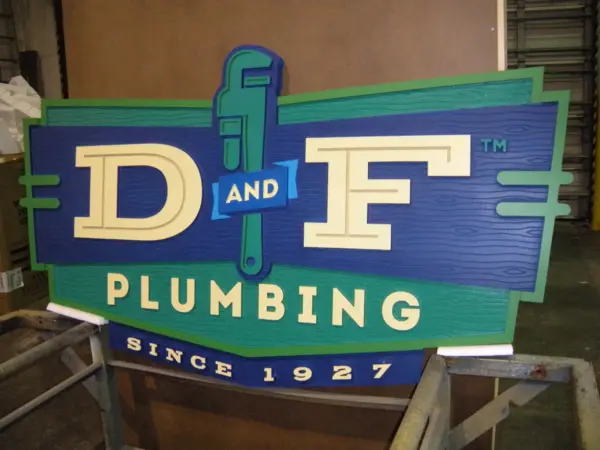
| Custom 3D foam signs | Dimensional logos, lettering and signage that define the first impression of a space. |
A quick finder: what do you need?
If you are not sure where your project belongs, this short list may help.
Many projects touch several categories. A retail launch might combine a window display, a lobby logo and an in-store replica. We are glad to quote them together so the design stays consistent.
How to choose the right product
Choosing between product lines comes down to four questions.
Where will it live? An outdoor piece needs a different coating and fixing from an indoor one, and a piece in a busy public space needs more protection from impact. How long must it last? A single event prop and a permanent monument sign share a material but not a construction standard. How will it travel? A touring display is built in sections with careful packaging, while a fixed installation can be larger and heavier. What will people do with it? Pieces that guests touch or climb need reinforcement that purely visual items do not.
Answering these four questions usually points to one or two product lines. Our team can help with the rest, and we will tell you plainly if a different material would suit the job better than foam.
Combining several product lines in one project
The catalog is organized for browsing, but real projects rarely respect the categories. A restaurant opening might need a monument sign at the road, illuminated letters over the door, a sculpture in the lobby and seasonal decor for the first winter. A mall campaign might call for a giant replica, a photo wall and a set of floating letters. Buying each of these from a different supplier is possible, but the result tends to feel assembled rather than designed.
When one manufacturer handles the whole set, the pieces share a model library, a color standard and a finishing process. Edges, textures and proportions match, and the brand looks consistent from the street to the reception desk. Scheduling gets easier as well, because one project manager coordinates production, shipping and installation windows for every item.
If you are planning a group of pieces, tell us about all of them in your first message, even those you may order later. We will suggest an order of production that suits your opening date and a budget that spreads across phases.
Scale and complexity: what is possible
Many clients ask how large a piece can be, or how complicated. In practice, the limits are set more by transport and installation than by fabrication. Large forms are divided into sections that fit through standard doors and elevators and then joined on site, with seams planned in advance so they disappear under the finish. Very large or sculptural shapes can be printed as single components on our large-format machines, which avoids joints altogether.
Complexity is handled in the digital model. Curves, undercuts, fine relief and repeated patterns are drawn once and cut accurately, which makes ornate work far more affordable than hand carving in stone or wood. If you have a design that has been called impossible to build, send it to us. We will tell you honestly what is feasible and what needs to change.
Materials, coatings and craft across the catalog
Most of what you see in the catalog is built on expanded polystyrene (EPS) or high-density urethane (HDU). EPS is the right choice for large, light forms. HDU holds fine detail and suits carved panels and routed signs. Many projects combine them, and some add printed parts, welded steel frames or metal and acrylic components.
What makes foam suitable for outdoor use is the finish. A polyurea hard coat and a painted layer work together to resist moisture, UV light, temperature swings and impact. Under correct use, our products are designed to last 10 to 20 years, and we back that with a 20-year warranty.
Detail work happens by hand. Wood grain, stone texture, concrete, metal finishes and weathered edges are applied by our finishers, and colors are matched against physical samples, including Pantone references, rather than screens.
From request to delivery
Every product line follows the same path. You describe your idea, through a sketch, a photo, technical drawings or a few sentences. We build a digital model, show you drawings and prepare samples where they help. Once you approve the design and the documentation, production begins. Pieces are cut, assembled, coated and finished, then packed into custom crates and shipped. A dedicated project manager stays with you through the whole process.
The average time from idea to finished object is between 15 and 30 days, although large or complex builds are scheduled individually. Delivery is nationwide, and installation sheets travel with the piece so your crew knows the order of assembly.
Industries we serve
The same catalog serves very different customers. Advertising agencies and experiential marketing teams use it for activations and events. Architects, developers and homeowner associations use it for facades, entrances and signage. Retailers and shopping centers use it for windows, interiors and seasonal displays. Trade show builders use it for exhibits. Theaters, film and television studios and theme parks use it for sets and themed environments. Museums, schools, hotels, restaurants and municipal clients use it for displays, signs and decorative features.
Custom is the default
You will notice that our catalog lists product lines rather than product codes. That is deliberate. Almost everything we make is designed for a specific client, space and message. If you do not see exactly what you imagine, describe it anyway. A large share of our best projects began with a request that did not fit any category.
The result
A good catalog should shorten your search, not lengthen it. We hope this overview has helped you see where your project fits and what to expect. The next step is easy: pick the product line that looks closest, open its page and send us your idea.
Ready to talk about your project?
Request a free quote from Royal Foam Art Design and tell us what you would like to build.